5 Cool Google Tricks Every Geek Should Know (2023 Edition)

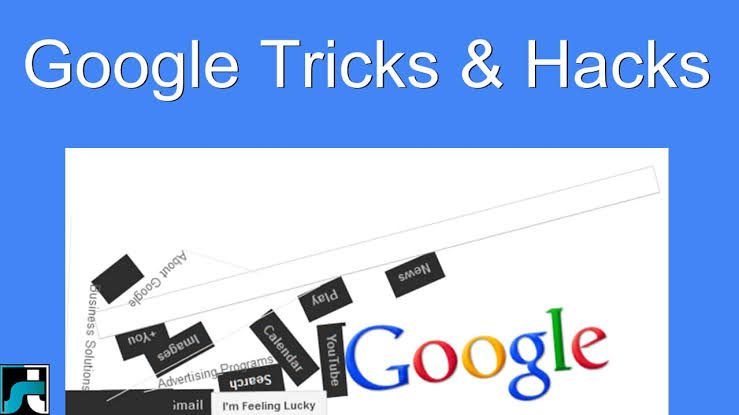
For many Internet users, Google is an integral part of life. We use the Google search engine almost on a daily basis to satisfy our unquenchable hunger for knowledge. So, it’s about time we take a break from that and look at some hidden Google tricks and easter eggs that the search engine hides behind a proverbial curtain.

Now, some readers might wonder what useful purpose these Google tricks serve. And the answer to that, to be honest, is basically none — they just exist for fun. These tricks are simply something you can show off to your friends or can learn to satisfy your geeky side.

Contents

1. Google Gravity
2. Askew
3. Thanos
4. Barrel Roll
5. Google underwater


Google Gravity
https://pagead2.googlesyndication.com/pagead/js/adsbygoogle.js?client=ca-pub-1234567890123456
This is the head of your page.
Example HTML page

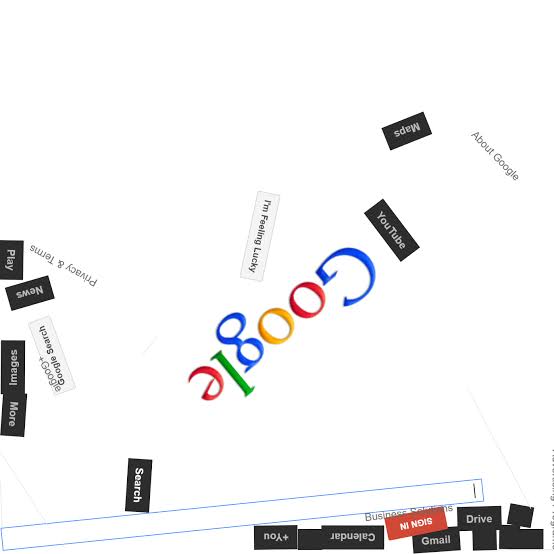
Google Gravity” is a fun, interactive web page created by Mr. Doob (a pseudonym for Ricardo Cabello), a web developer and designer. The page can be accessed at http://mrdoob.com/projects/chromeexperiments/google-gravity/.

When you visit the Google Gravity page, you will see the familiar Google search bar and logo at the top of the page. However, as soon as the page finishes loading, everything falls apart and starts to behave as if it were affected by gravity. The search bar, the logo, and other elements on the page will fall to the bottom of the browser window and bounce around as if they were affected by the Earth’s gravity.

You can interact with the elements on the page by dragging them around with your mouse, throwing them around, or even making them explode by double-clicking on them. However, you won’t be able to perform an actual search on this page, as the search bar is purely for entertainment purposes.

Overall, Google Gravity is a fun and entertaining way to waste a few minutes of your time.

Askew
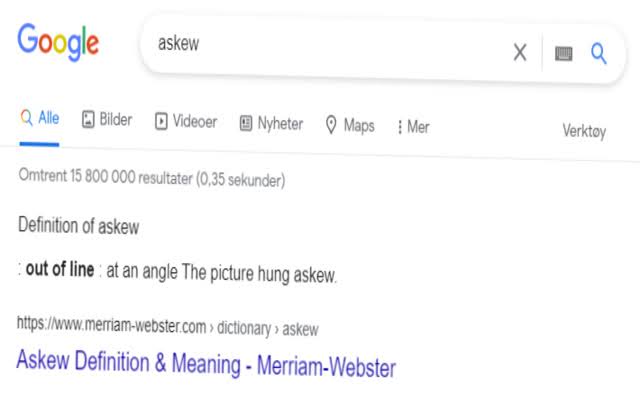
If you search for the term “askew” on Google, the search results page will tilt slightly to the right. This is a small Easter egg or hidden feature that Google has implemented to add a bit of fun and surprise to the search experience.

The tilt effect is a result of a simple CSS code that tilts the entire page by a few degrees. While it may not serve any practical purpose, it is a clever and playful way to showcase Google’s attention to detail and creativity.

Google has a history of incorporating Easter eggs and hidden features into its products, such as the “I’m feeling lucky” button and the “do a barrel roll” search query, which rotate the search results page. These features add a touch of humor and fun to the search experience and are appreciated by many users.

Thanos
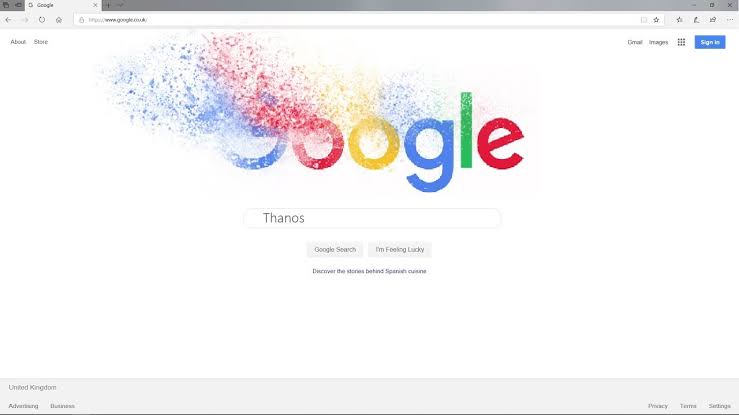
Thanos” is a character from the Marvel Cinematic Universe and the main antagonist in the movie “Avengers: Infinity War” and “Avengers: Endgame”. In the movies, Thanos is a powerful alien being who seeks to restore balance to the universe by using the Infinity Stones to wipe out half of all life in the universe.

In addition to his appearance in the movies, Thanos has also been featured in various other Marvel comics, cartoons, and video games. However, when it comes to Google, there is a special “Thanos” Easter egg that was implemented by the search engine giant.

If you search for “Thanos” on Google and click on the Infinity Gauntlet icon on the right-hand side of the screen, the search results page will turn to dust and disintegrate, just like the ending of “Avengers: Infinity War”. After a few seconds, the page will reassemble itself, much like the events of “Avengers: Endgame”. This is a fun and creative way for Google to pay homage to one of the most iconic and memorable moments in the Marvel Cinematic Universe.

Barrel Roll
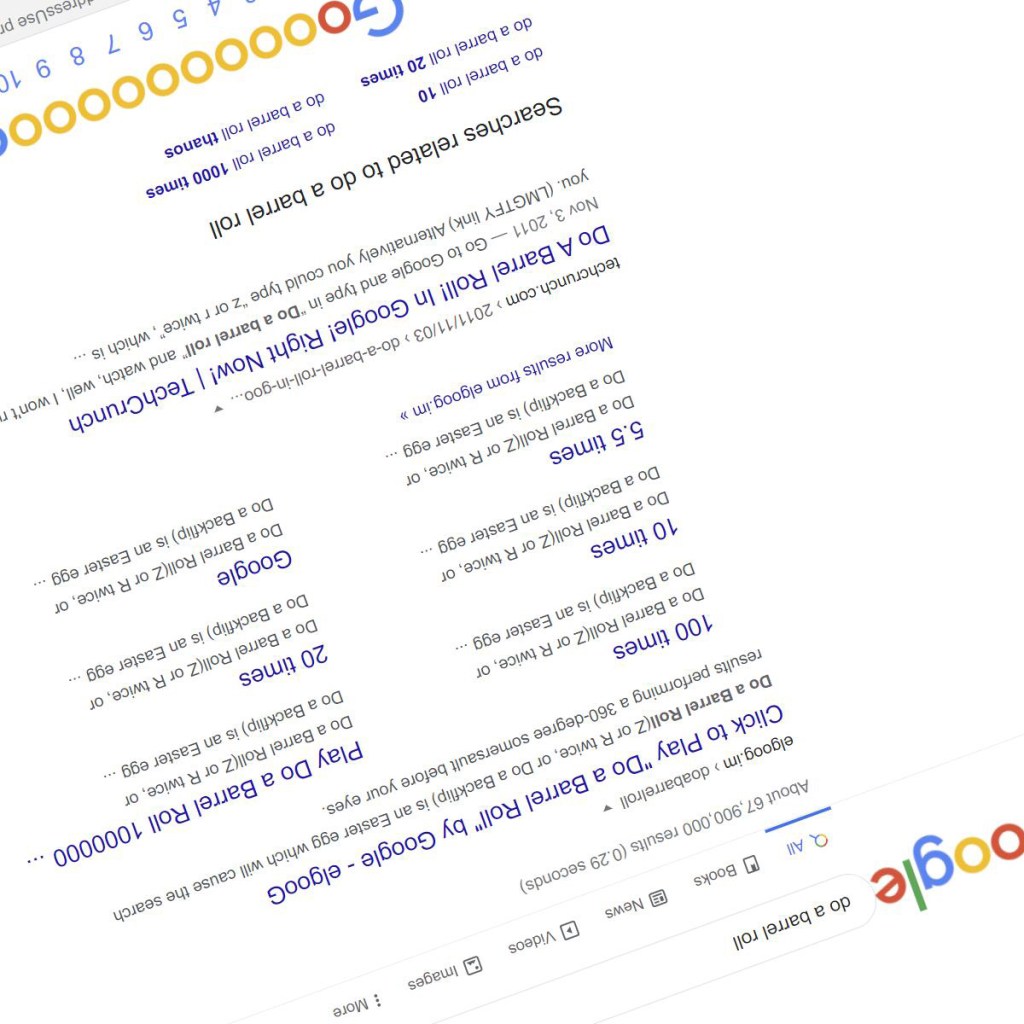
“Barrel Roll” is a well-known Easter egg or hidden feature on Google that rotates the search results page by 360 degrees. If you type the phrase “do a barrel roll” into the Google search bar and hit enter, the search results page will perform a complete barrel roll or flip, which can be a fun and surprising experience for users.

This Easter egg was implemented by Google as a playful way to showcase its programming skills and attention to detail. The barrel roll effect is achieved using a simple CSS3 code that rotates the entire page by 360 degrees when the search results are displayed.

Since its implementation, the “barrel roll” Easter egg has become quite popular among Google users, and it has inspired other hidden features like the “tilt” effect, which tilts the search results page slightly when you search for the word “askew”. These features add a bit of fun and entertainment to the Google search experience and are appreciated by many users

Google Underwater
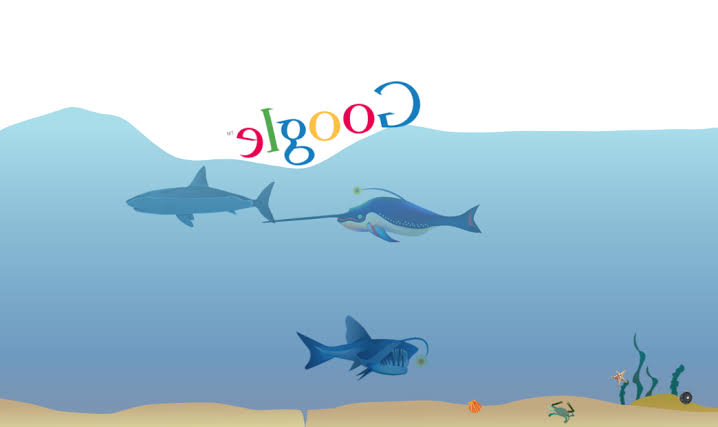
“Google Underwater” is not an official feature or Easter egg of Google, but there are various websites and Chrome extensions that allow you to experience Google in an underwater setting.

One of the popular websites that offer this experience is called “Google Underwater Search”. When you visit the site, you will see a Google search bar and logo in an underwater setting, complete with marine life and bubbles. You can type in your search query and hit enter to see the search results, which will appear in a floating box that looks like a bubble. You can also click on the various marine creatures to see fun facts and information about them.

There are also various Chrome extensions that offer similar underwater experiences, such as “Underwater Google” and “Underwater World”. These extensions allow you to set Google as your default search engine and give you an underwater background for your search experience.

Overall, Google Underwater is a fun and entertaining way to experience Google in a different setting. However, it is important to note that these websites and extensions are not affiliated with Google and should be used at your own risk

https://pagead2.googlesyndication.com/pagead/js/adsbygoogle.js?client=ca-pub-2031703136622198

What Is SEO – Search Engine Optimization?

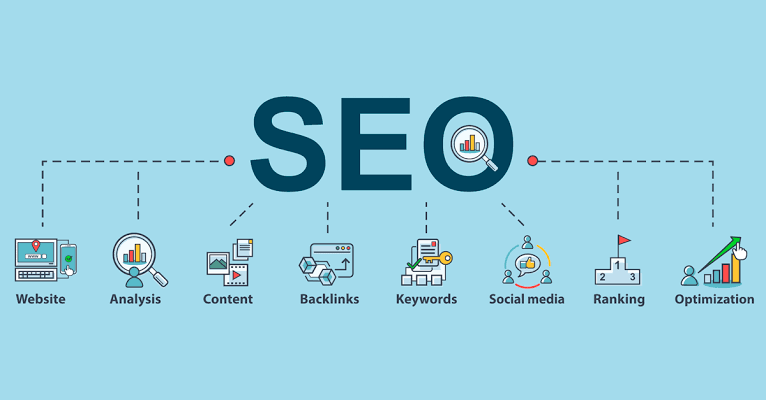
SEO stands for “Search Engine Optimization”. It is the process of optimizing a website or webpage to improve its visibility and ranking on search engine results pages (SERPs). The ultimate goal of SEO is to increase organic traffic to a website from search engines like Google, Bing, or Yahoo.
SEO involves various techniques that help search engines understand the content and context of a webpage so that it can be ranked appropriately for relevant search queries. These techniques include optimizing website structure, content, and HTML tags, as well as building high-quality backlinks to the website from other authoritative sites.

The practice of SEO has become increasingly important in recent years as more and more businesses compete for visibility on the internet. By optimizing their websites for search engines, businesses can improve their online presence and attract more potential customers to their website

A short history of the Web

The World Wide Web, or simply the Web, was created in 1989 by British computer scientist Sir Tim Berners-Lee while working at CERN, the European Organization for Nuclear Research. Berners-Lee was looking for a way to share information between researchers in different locations and came up with the idea of using hypertext links to connect documents and make them accessible over the internet.

The first website went live in 1991, providing information about the World Wide Web project and how to use it. In the early days, the Web was primarily used by academics and researchers to share information and collaborate on projects.

In 1993, the first popular web browser, Mosaic, was released by the National Center for Supercomputing Applications (NCSA) at the University of Illinois. This made it easier for people to access and browse the Web, and helped to popularize the medium.

The mid-to-late 1990s saw a rapid growth in the number of websites and users on the Web, as businesses and individuals began to recognize its potential for communication, commerce, and entertainment. The introduction of search engines like Yahoo! and Google made it easier to find information on the Web, while social networking sites like Friendster and MySpace helped to connect people with each other.

The 2000s saw the rise of Web 2.0, a term coined to describe a shift towards more interactive and collaborative websites. This was characterized by the growth of social media platforms like Facebook and Twitter, as well as user-generated content sites like Wikipedia and YouTube.

Today, the Web is a ubiquitous part of modern life, with billions of websites and users around the world. It has transformed how we communicate, work, shop, and entertain ourselves, and continues to evolve with new technologies like artificial intelligence, virtual reality, and the Internet of Things

Why is SEO important?

To understand the value of SEO, let’s break our definition into three parts:

1. Organic search results: the unpaid listings on a search engine results page (SERP) that the search engine has determined are most relevant to the user’s query. Ads (in this context, PPC or pay-per-click ads) make up a significant portion of many SERPs. Organic search results are distinct from these ads in that they are positioned based on the search engine’s organic ranking algorithms rather than advertiser bids. You can’t pay for your page to rank higher in organic search results.

How Does SEO Work ?

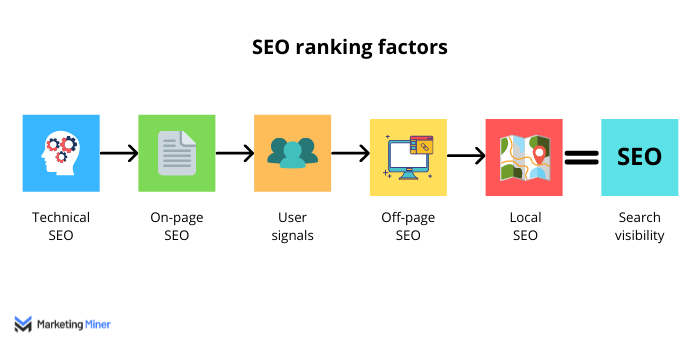
SEO works by optimizing a website or webpage to make it more visible and relevant to search engines for particular keywords or search queries. There are several key components of SEO that work together to achieve this:

1. On-page optimization: This involves optimizing the content and structure of a webpage to make it more relevant to a particular keyword or search query. This includes optimizing page titles, headings, meta descriptions, and image alt tags, as well as ensuring that the content is high-quality and relevant to the search query.

2. Off-page optimization: This involves building high-quality backlinks to a website from other authoritative sites. The quality and relevance of these backlinks can help to improve the website’s authority and ranking on search engines.

3. Technical optimization: This involves optimizing the technical structure of a website to ensure that it is easily crawlable and indexable by search engines. This includes optimizing site speed, implementing schema markup, and ensuring that the website is mobile-friendly.

4. User experience: This involves optimizing the website’s user experience to ensure that it is easy to use and navigate. This can include improving site architecture, ensuring fast load times, and providing high-quality content that meets the user’s needs.

How does search engine works ?

Search engines are computer programs that allow users to search for information on the internet. They work by using a process called web crawling, indexing, and ranking to gather and organize web pages and other online content.

Here’s a simplified overview of how search engines work:

Web crawling: The search engine sends out automated programs called “crawlers” or “spiders” to visit and read web pages on the internet. The crawlers follow links from one page to another, and they use algorithms to determine which pages to visit next.

Indexing: As the crawlers visit web pages, they gather information about the content of each page and store it in a database called an index. This information can include the text on the page, as well as metadata such as the page title, URL, and any links to other pages.

Ranking: When a user enters a search query into the search engine, the search engine uses an algorithm to determine which pages in its index are the most relevant to the query. The algorithm takes into account a variety of factors, including the keywords used in the query, the relevance and authority of the page content, and the user’s location and search history.

Displaying results: The search engine displays a list of search results, usually in order of relevance or importance, along with brief snippets of text from each page. The user can then click on a link to visit the page and read more.

Search engines are constantly refining and improving their algorithms to provide more accurate and relevant search results to users

What is Google algorithm ?

Google algorithm refers to the complex system of rules and processes that Google uses to determine the order in which web pages appear in its search engine results pages (SERPs). Google’s algorithm is constantly evolving, with updates and changes made on a regular basis to improve the quality and relevance of its search results.

The Google algorithm considers hundreds of different factors when ranking web pages, including:

Keywords: The words and phrases that users enter into the search bar.

Content quality: The relevance, depth, and originality of the content on the page.

User experience: Factors such as page speed, mobile-friendliness, and usability.